HAM THE FATHER OF CANAAN
THE CURSE OF CANAAN EXPOSED
In
the
Ancient-Hebrew
(Canaanite)
language,
the
name
Ham
(
Kham
)
means
:
'
Father-in-law
of
wife
'.
And
as
an
adjective
means
:
Black
and
warm.
In
Ancient
Canaanite-Hebrew
letters
it
is
spelled
:
Heth,
Mem
(KHM)
and
pronounced
as
:
Kham
.
He
was
also
known
as
“Cham”
and
“Yonika”.
Born
2446
B.C.
at
Shulon,
East
Eden
and
died
2004
B.C.
in
the
Land
of
Canaan.
Ham
was
the
son
of
Noah
and
Naamah.
He
had
4
wives:
Egyptus;
Sare;
Nahlab;
and
Ne'elatama'uk.
Ham
(
Kham
)
was
a
son
of
Noah
-GENESIS
10:
1
.
Ham's
(
Kham's
)
mother
was
Emzârâ
-THE
BOOK
OF
JUBILEES
4:
33
.
Ham
(
Kham
)
and
his
wife
Ne'elatama'uk
-THE
BOOK
OF
JUBILEES
7:
13-14
,
are
the
common
Paternal
Blood-Line
ancestors
of
Black
Hamitic
speaking race groups of the earth (after the Great Flood).
Now please consider
-GENESIS 8: 4
which reads as follows...
..."And
the
ark
rested
in
the
seventh
month,
on
the
seventeenth
day
of
the
month,
on
the
mountains of 'Ararat"... -GENESIS 8: 4
Please Take Note :
..."
On the mountains of 'Ararat
"...
'Mountains of Ararat' signifies a mountainous region in the land of 'Ararat. Let's continue on
with -GENESIS 8: 5; which reads as follows...
..."And
the
water
decreased
continually
until
the
tenth
month:
in
the
tenth
month,
on
the
first
day of the month, were
THE TOP OF THE MOUNTAINS SEEN
"...
-GENESIS 8: 5
Please Take Note :
..."
THE TOP OF THE MOUNTAINS SEEN
"...
This verse indicates that other mountain peaks became visible as the ark of Noah sat on the
mountainous region of the land of 'Ararat. This verse indicates that the ark of Noah probably
sat on the highest mountain, of the mountainous region of the ancient land of 'Ararat. The
highest mountain that was in the mountainous region of the ancient land of 'Ararat is today
called the mountains of Zagros, located in Western Iran. This region is where the eight (8)
persons who survived the Great Flood disembarked from the ark -GENESIS 7: 13; -GENESIS
8: 16; -GENESIS 8: 18.
Let us continue on with
-GENESIS 11: 1
; which reads as follows...
..."Now
the
whole
earth
was
of
one
language
and
one
speech.
And
it
came
to
pass,
AS
THEY
JOURNEYED
FROM
THE
EAST
that
they
found
a
plain
in
the
Land
of
Shinar
and
they
dwelt
there"...
-GENESIS 11: 1
Please Take Note :
..."
Now the whole earth was of one language and one speech
"...
This
indicates
that
"the
whole
earth
(all
survivors
of
the
Great
Flood),
who
happened
to
be
all
descendents
of
Noah
(of
the
one
and
very
same
tribe),
all
spoke
the
one
and
very
same
language and used the one and very same words, prior to their arrival in the Land of Shinar.
Let's continue on :
..."And it came to pass,
AS THEY JOURNEYED FROM THE EAST
"...
Here
the
Holy
Bible
gives
us
a
clear
direction
for
the
landing
place
of
the
Ark,
and
it
was
not
in
the
direction
of
today's
Turkey,
or
in
the
direction
of
today's
Armenia
(as
is
commonly
believed).
The
Holy
Bible
says
that
"the
whole
earth
(the
tribe
of
Noah
who
survived
the
Great
Flood)
journeyed
from
the
East"
and
then
settled
in
the
"Land
of
Shinar".
Which
infact
was
the
ancient
name
of
the
Land
of
Nimrod
,
who
was
a
son
of
Cush
,
the
1st
son
of
Ham
(
Kham
)
-
GENESIS 10: 6-10
.
Now,
if
the
survivors
of
the
Great
Flood
journeyed
from
the
East,
they
would
have
come
from
the
land
in
the
direction
of
present
day
Iran.
The
Hamitic
descendents
of
Noah
surely
traveled
down
the
Diyala
River
(from
the
East)
while
migrating
down
from
the
Mountains
of
'Ararat
into
the plain or valley of Shinar.
Please Take Note :
The
Septuagint
translation
of
the
Ancient-Hebrew
(Canaanite)
Bible
into
Greek,
in
250
B.C.E.,
reads
:
"
From
the
East
"
-GENESIS
11:
2
.
This
is
significant
since
these
Greek-speaking
Hebrews
who
lived
in
Africa
(Egypt),
knew
the
exact
equivalent
of
the
Hebrew
into
the
Greek
and
chose
a
preposition
(
apo
),
that
only
means
:
‘
From
',
and
not
‘In’,
or
‘Towards’,
or
‘Eastward’.
Let's continue on :
..."They found a plain in the Land of Shinar and they dwelt there"...
Please Take Note :
The
Holy
Bible
tells
us
that
Nimrod
(who
was
Hamitic
),
founded
the
cities
:
Babel,
Erech,
Accad,
and
Calneh,
in
the
land
of
Shinar
(today's
Southern
Iraq)
-GENESIS
10:
8-10
;
and
also
Nineveh,
Rehoboth,
Calah,
and
Resen,
in
the
land
of
Ashur
(today's
Northern
Iraq)
-
GENESIS
10:
11-12
.
The
ancient
land
of
Shinar
(today's
Southern
Iraq)
and
the
ancient
land
of
Ashur
(today's
Northern
Iraq)
was
first
ruled
by
Nimrod
and
that
whole
region
was
known
as :
the land of Nimrod
-MICHA 5: 5-6
.
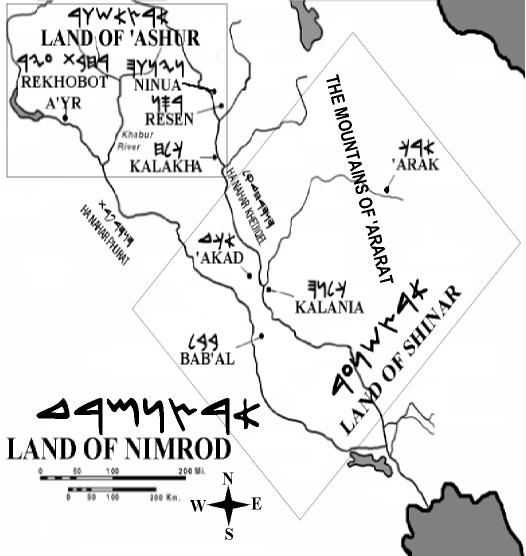
THE LAND OF NIMROD
THE ANCIENT LAND OF SHINAR
(Today’s Southern Iraq)
1.)
'ARAK
(Erech)
-
A
city
of
the
kingdom
of
Nimrod
.
The
place
where
Noah
built
the
1st
altar
after
the
Great
Flood
-GENESIS
8:
20
.
Located
in
the
mountains
of
Ararat
(Zagros)
in
today's
Westeren Iran.
2.)
KALANIA
(Calneh
or
Calno)
-
A
city
of
the
kingdom
of
Nimrod
.
The
place
where
the
1st
Tower
was
built
after
the
Great
Flood
-ISAIAH
10:
9
Septuagint
(LXX
)
.
Located
in
today's
Easteren Iraq. On the right-bank of the Khediqel and Diyala rivers.
3.)
BAB'AL
(Babel)
-
A
city
of
the
kingdom
of
Nimrod
.
The
1st
principal
Hamitic
city
built
after
the
Great
Flood
and
place
of
the
dispersal.
Where
multi-culturalism
was
created
-GENESIS
11: 8-9
. Located in today's Southern Iraq. On the right-bank of the Phurat river.
4.)
'AKAD
(Accad)
-
A
city
of
the
kingdom
of
Nimrod
.
Located
in
today's
Southern
Iraq.
On
the left-bank of the Khediqel river.
THE ANCIENT LAND OF ASHUR
(Today’s Northeren Iraq)
5.)
KALAKHA
(Calah)
-
A
city
of
the
kingdom
of
Nimrod
.
Located
in
today's
Northeren
Iraq.
On the right-bank of the Khediqel river.
6.)
RESEN
-
A
city
of
the
kingdom
of
Nimrod
.
Located
in
today's
Northeren
Iraq.
On
the
right-
bank of the Khediqel river.
7.)
NINUA
(Nineveh)
-
A
city
of
the
kingdom
of
Nimrod
.
Located
in
today's
Northeren
Iraq.
On
the right-bank of the Khediqel river.
8.)
REKHOBOT
A'YR
(Rekhobot
A'yr)
-
A
city
of
the
kingdom
of
Nimrod
.
Located
in
today's
Northeren Iraq. On the right-bank of the Phurat river.
Let us now please consider
-GENESIS 9: 18-19
; which reads as follows...
..."The
sons
of
Noah
who
went
forth
out
of
the
ark
were
Shem
and
HAM
and
Japheth
;
AND
HAM
IS
THE
FATHER
OF
CANAAN
.
These
three
were
the
sons
of
Noah
;
and
from
them
the
people spread throughout the earth"...
-GENESIS 9: 18-19
Please Carefully Take Note :
..."
HAM
IS THE FATHER OF
CANAAN
"...
The
Hamites
were
actually
'The
Mutitude'
at
that
time
just
after
the
Great
Flood
(according
to
the Holy Bible).
Through
a
quick
perusal
of
the
genealogical
table
recorded
in
-GENESIS
10
of
the
Holy
Bible,
we
discoverd
that
HAM
HAD
THIRTY
(
30
)
DESCENDANTS
,
Shem
had
26
,
and
Japheth
had
only
14
.
Consequently,
it
is
very
easy
to
understand
how
and
why,
the
dominant
race,
language,
and
culture,
of
the
ancient
world
(just
after
the
Great
Flood),
was
infact,
Hamitic
;
because
humanity at that particular time was predominantly
Hamitic
.

THE HAMITIC DISPERSAL FROM BAB’AL
During
the
Hamitic
dispersion
-GENESIS
11:
8-9
;
from
the
city
of
Nimrod
(Babel),
which
was
in
the
land
of
Shinar
-GENESIS
10:
10
;
also
called
the
land
of
Nimrod
and
in
the
Ancient-
Hebrew
(Canaanite)
Language
called
Kush
(
Cush
)
before
the
Great
Flood
-GENESIS
2:
13
.
Ham
and
his
offspring
(all
except
Nimrod
and
his
offspring
and
followers),
traveled
to
a
uninhabited
land
in
today's
Southren
Israel-Palestine.
There
they
settled
and
called
it
:
the
land of
Ham
(
Kham
)
-1 CHRONICLES 4: 40
.
THE SONS OF HAM
1)
CUSH
-
Lived
in
the
land
of
Ham
before
migration
to
Nubia.
His
descendants,
the
Cushites
,
were
the
very
first
after
the
Great
Flood
to
inhabit
the
land
that
is
today
called
Sudan
(the
ancient Nubia).
2.)
NIMROD
-
Nimrod
(and
his
descendants
the
Nimrodians
),
was
the
very
first
and
world's
only
known
utopian
ruler
ever
to
be
since
the
Great
Flood.
He
and
his
descendants
were
the
very
first
founders
and
rulers
of
ancient
city
of
Babel
and
Old-Babylonian
and
Assyrian
empires of ancient Mesopotamia.
3.)
MIZRAIM
-
Mitsraim
lived
in
the
land
of
Ham
before
migration
to
Egypt.
Mizraim
were
the
very first inhabitants of the ancient upper and lower Egypt after the Great Flood.
4.)
PUT
-
Descendants
of
Canaan
who
lived
in
the
land
of
Ham
before
migration
to
Northern
Canaan
(today's
Lebanon-Israel)
and
on
to
Carthage
of
North
Africa
(which
they
founded)
and
on
to
New
Carthage
of
Spain
and
from
there
on
as
far
as
to
the
Americas.
The
Neo-Punics
(
Neo-Canaanites
or
Neo-Phoenicians)
were
inhabitants
after
the
Great
Flood
of
the
ancient
Syro-Canaan and Libya. Today's Syria, Lebanon, and North Africa.
5.)
CANAAN
-
Canaan
lived
in
the
land
of
Ham
before
migration
to
Shekhem
where
he
ruled
as
the
very
first
King-Priest
of
Shalem.
His
descendants
were
the
very
first
inhabitants
after
the Great Flood of Syria, Lebanon, Israel-Palestine (the ancient land of
Canaan
).
Ham
is
the
only
son
of
Noah
to
have
had
a
land
named
after
him.
The
Egyptian
name
Kam
or
Kamit
is
the
ancient
Khamitic
(
Hamitic
)
name
for
today's
Egypt.
In
the
Ancient-Hebrew
(
Canaanite
)
language
it
is
Kham
.
The
ancient
land
of
Ham
to
start
was
located
at
the
southren
extremity
of
Judah
in
Gerarah
(Gerar)
-GENESIS
10:
19
(called
valley
of
Gedor
in
-1
CHRONICLES
4:
39-40
),
between
Gaza
and
Beer-Sheba;
13
miles
South-West
of
Bethlehem, in today's Mediterranean-Asia.
After
the
dispersion
from
the
land
of
Shinar
(the
ancient
land
of
Nimrod
in
today's
Iraq),
the
Hamites
settled
in
a
valley
of
Southren
Judah
and
called
it
Gerarah
(Gerar/Gedor).
There
they
built
a
city
which
they
also
called
Gerarah
(Gerar/Gedor)
-JOSHUA
15:
58
.
The
Casluhim
(called
Hashmannim
"Princes"),
who
descended
from
Ham's
offspring
Mitsraim
(out
of
whom
came
the
Philistim
-GENESIS
10:
13-14
),
were
the
first
rulers
of
Gerarah
(Gerar/Gedor).
During
Isaac's
time
-GENESIS
26:
6
,
at
which
time
the
Casluhim
(Hashmannim
"Princes")
had
already
migrated
to
Syria,
their
descendants
the
Philistim
ruled
Gerarah
(Gerar/Gedor)
-
GENESIS 26: 1
.
When Ham's son Canaan departed from the valley of Gerarah (Gerar/Gedor), he traveled to a
uninhabited land located between Mount Ebal and Mount Gerizim. There he built a walled city,
with a gate and called it Shalem (Salem). Canaan was the very first King of Shalem (Salem)
and held the Throne Name which is written in Ancient-Hebrew (Canaanite) letters as :
; and spelled as : Mem, Lamed, Kop, Yod, Tsade, Dalet, Qof, [MLKYTSDQ] and
pronounced as : Malki-tsedeq. Which means : King of Justice -GENESIS 14: 18. The city of
Shalem (Salem) was in the Province of Shekhem of the land of Canaan (-GENESIS 33: 18
Aramaic Peshitta; -GENESIS 33: 18 The Septuagint; -GENESIS 33: 18 King James
Version).
The
land
of
Canaan
(today's
Israel-Palestine),
was
the
homeland
of
a
group
of
Hamitic
people
known
as
the
Canaanites
.
By
the
third
millennium
B.C.E.
the
Hamitic
Canaanites
were
living
in
cities,
one
of
which
was
Jericho.
They
developed
an
alphabet
from
which
other
writing
systems
originated
and
their
religion,
had
a
major
influence
on
that
of
the
ancient
A'barim
(
Hebrews
) and through them on both Christianity and Islam.


By Titus Williams (Aka : Moreh Yaabez)
Copyright - NATSIRI ISRAEL - All Rights Reserved